

The Inventory
Practice Eight: Commitment Audit & Right-Sizing


Dear Reader,
There is a specific kind of clutter that does not announce itself.
It does not accumulate on countertops or in closets. It accumulates on your calendar, in your inbox, in the low-grade obligations you agreed to once and have been quietly carrying since. It lives in the yeses you gave before you understood the full cost, and in the commitments you renewed out of loyalty to a version of yourself that no longer exists.
Depletion rarely comes from any single commitment. It comes from the cumulative weight of all of them together, the weight you have stopped noticing because you have been carrying it so long.
The Commitment Audit does not begin with the question of what to remove. It begins earlier, with an honest inventory of everything you are carrying, and what each item is actually costing you.
‘No’ to one thing is ‘yes’ to something else. Usually yourself.

Most accomplished women overcommit not from poor judgment but from unclear visibility. The commitments accumulate gradually, each one reasonable on its own terms. It is only when you lay them all in front of you at once that the cumulative weight becomes legible.
High energy cost paired with low meaning is not ambition. It is a resentment breeding ground. This practice makes that visible and asks you to choose deliberately.

Duration: 30 to 45 minutes, quarterly.
1. List everything you are committed to across all domains: work, family, relationships, community, health, personal projects. Include the commitments so embedded in your routine they no longer register as choices.
2. For each commitment, rate three dimensions on a scale of 1 to 10: Energy cost (what does this take from you?), Meaning and value alignment (does this belong to the life you are building?), Necessity (does this require you specifically?).
3. Categorize each commitment:
KEEP: High meaning, sustainable cost. This commitment earns its place.
RESIZE: Important, but the current form is unsustainable. The commitment stays. The shape changes.
RELEASE: Low meaning, high cost, not essential. This one has been costing more than it is worth.
DELEGATE: Necessary, but does not require you specifically. You have been holding this when someone else could carry it.
4. Choose one commitment to release or resize this week. One. The audit is not a single session of radical subtraction. It is an ongoing practice of maintaining congruence between what you carry and who you are becoming.
When you identify something in the RELEASE category, notice what the resistance feels like. Guilt and identity are both stored in obligation. It is worth knowing which one is speaking
before you act. Sometimes what feels like loyalty is an old story about what you are allowed to need. The audit helps you tell the difference.
Download your Commitment Audit Worksheet → bloomlifegps.substack.com/worksheets
Reflection: What is one commitment you are currently carrying that belongs to a previous version of you? Not a wrong version, an earlier one. What would it mean to release it with gratitude rather than with guilt?


Watch: Abstract: The Art of Design, Ilse Crawford episode (Netflix)
Interior designer Ilse Crawford builds spaces around one question: what does it mean to live well, not impressively, but well. Her process is slow, deliberate, and deeply attentive to what human beings actually need in the spaces they inhabit. Watching her work is a tutorial in right-sizing, in the discipline of removing what does not serve in order to make room for what does. The principles she applies to physical space are the same ones this practice applies to time.
Abstract: The Art of Design, Netflix

Nourish: Wild mushroom risotto with aged Parmigiano and black truffle at Fiola, Washington D.C.
Risotto cannot be rushed. It is a dish that requires presence at every stage, consistent attention, a willingness to stay with something through slow transformation. Order it as a deliberate counterpoint to the pace at which you have been moving. Let the meal ask something specific of you: that you slow down enough to taste it.
Fiola, Washington D.C.
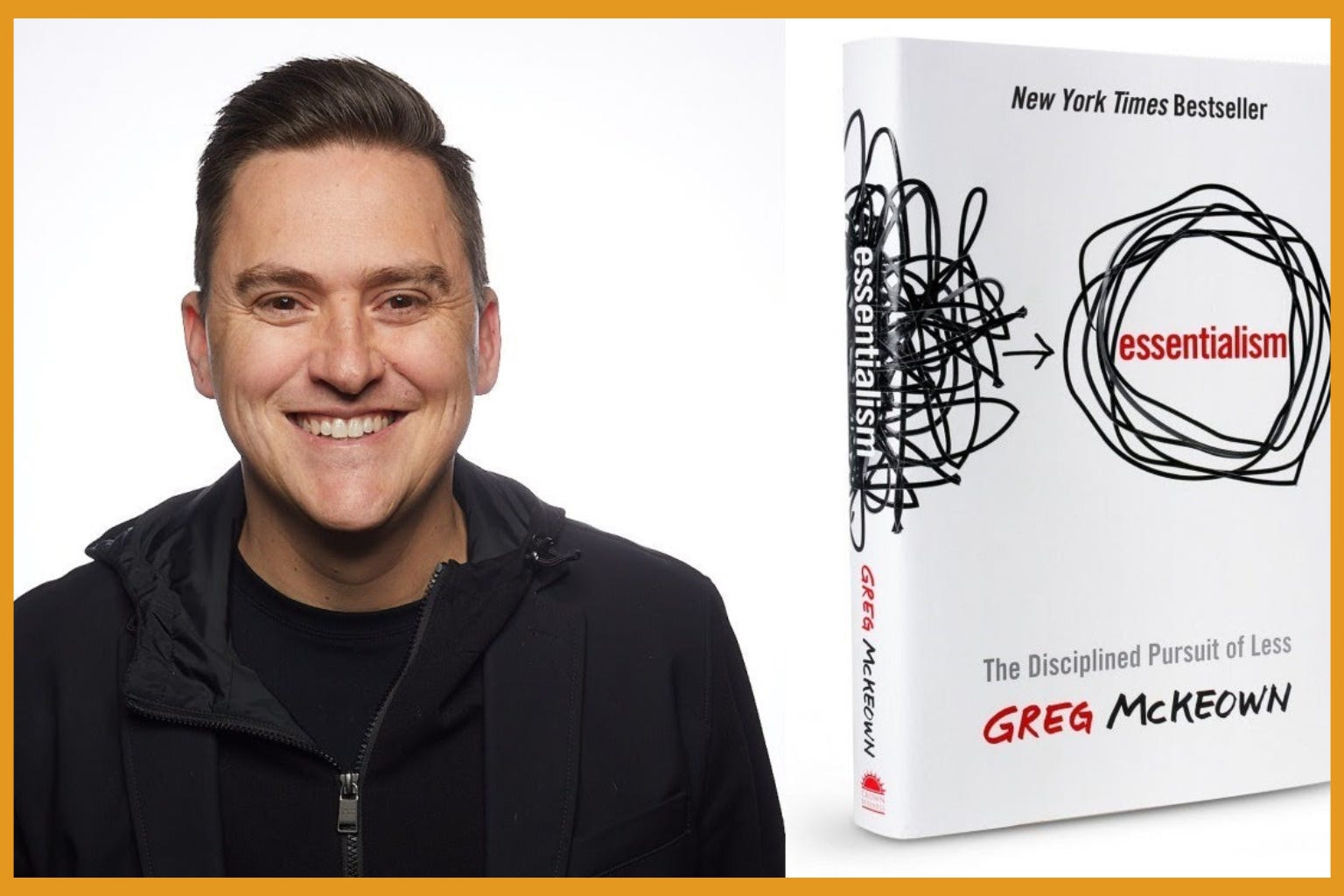
Read: Essentialism: The Disciplined Pursuit of Less by Greg McKeown
McKeown’s central argument is that the undisciplined pursuit of more is not ambition. It is a failure of discernment. His case for the essentialist life, deliberate, selective, unhurried, reads in some places as a business book and in others as something closer to a philosophical practice. Read it alongside your audit. Let it give language to the choices you are already sensing you need to make.
Essentialism, Greg McKeown — available at most independent booksellers
You are becoming. Take your time.
Doranna